
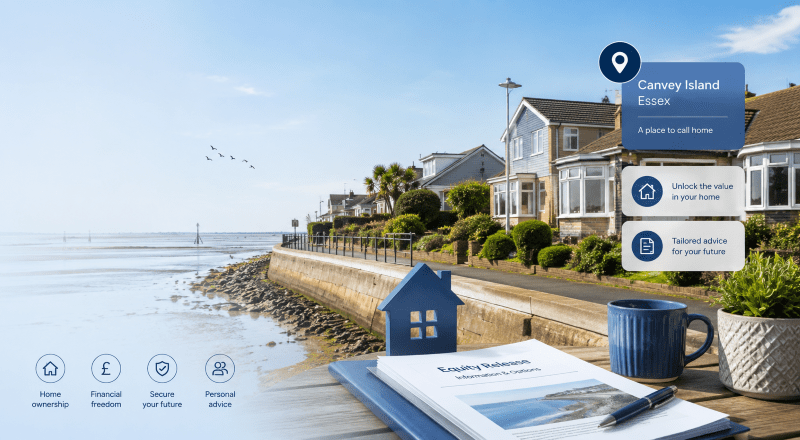
A home may have risen in value over many years. However, its market price is only one part of an equity release assessment.
The provider must also consider the property’s construction, condition, location and likely future resale.
An Equity Release Adviser in Canvey Island can explain how these checks may affect a lifetime mortgage application.
The purpose is not simply to confirm how much equity exists. It is to establish how much may be accessed responsibly.
At a Glance
An equity release provider may review:
- Your age
- The property’s market value
- Its construction and condition
- Flood and environmental information
- Any existing mortgage
- Lease terms, where applicable
- The amount you want to release
- Future moving plans
- The provider’s individual criteria
Equity release can reduce the value of your estate and may affect means-tested benefits.
What Is Equity Release?
Equity release may allow eligible homeowners to access part of the value held within their property.
A lifetime mortgage is the most common form.
It is a loan secured against your home. You remain the property owner, subject to the mortgage terms.
The loan is normally repaid when the last borrower dies or moves permanently into long-term care.
Some plans do not require compulsory monthly payments. Instead, unpaid interest is added to the mortgage balance.
Our guide to how equity release works explains the main stages.
Why Does the Property Need to Be Valued?
The provider needs an independent view of the property’s value and suitability.
The valuation may consider:
- The type and age of the property
- General condition
- Evidence of structural movement
- Construction materials
- Local demand
- Access and boundaries
- Nearby commercial activity
- Flood-related information
- Future resale prospects
The provider’s valuation may differ from an estate agent’s estimate or online property value.
A lower valuation can reduce the maximum amount available.
Can Flood Risk Affect Equity Release?
Flood risk does not automatically prevent equity release.
However, the provider may consider whether:
- The property can be insured
- Flooding has occurred previously
- Protective work has been completed
- Insurance terms include restrictions
- The issue could affect future resale
Canvey Island’s coastal setting makes environmental and insurance checks particularly relevant.
The provider may request further evidence where a property has a known history of flooding or insurance difficulty.
Government information about long-term flood exposure is available through the GOV.UK flood risk service.
Does Property Construction Matter?
Yes.
Many providers accept standard brick and tile homes. Other forms of construction may require closer assessment.
These can include:
- Concrete construction
- Timber-framed homes
- Prefabricated properties
- Properties with flat roofs
- Homes with significant extensions
- Buildings affected by structural movement
An unusual construction type does not always prevent lending. However, it may reduce the number of providers available.
An adviser should identify possible concerns before a full application is submitted.
What Happens If There Is an Existing Mortgage?
Any existing mortgage or secured loan normally needs to be repaid when the lifetime mortgage completes.
For example, suppose the new plan releases £90,000 and the existing mortgage balance is £25,000.
The existing £25,000 would usually be repaid first. The remaining funds would then be available, subject to fees and completion requirements.
The adviser should also consider whether the existing mortgage could be:
- Extended
- Remortgaged
- Replaced with retirement interest-only borrowing
- Repaid through savings
- Reduced by downsizing
Connect Mortgages explains how a conventional remortgage to release equity may work where income and affordability support that route.
How Much Could You Release?
The amount available may depend on:
- The youngest homeowner’s age
- Property value
- Existing secured borrowing
- Health and lifestyle information
- The plan selected
- Provider criteria
- Whether funds are taken as a lump sum or drawdown
The maximum available amount is not automatically the suitable amount.
Borrowing more than required means interest may be charged on money that is not immediately needed.
Our guide explains how much equity you may be able to release.
Lump Sum or Drawdown?
A lump-sum lifetime mortgage releases the agreed amount at completion.
A drawdown plan provides an initial release and a reserve for later withdrawals.
Interest is normally charged only after money is withdrawn.
Drawdown may be suitable where future spending is expected for:
- Home repairs
- Property adaptations
- Family support
- Care-related needs
- A future vehicle
- Emergency costs
Future withdrawals remain subject to the product terms.
What Should an Adviser Review?
The advice process should consider:
- Why the money is needed
- The amount required
- Income and spending
- Savings and investments
- Existing debts
- Benefits entitlement
- Inheritance preferences
- Moving plans
- Possible future care needs
- Alternative ways to raise the money
The property enables the borrowing. Your wider circumstances determine whether it may be suitable.
Speak to an Equity Release Adviser in Canvey Island
Connect Lifetime Mortgages can help Canvey Island homeowners review lifetime mortgages and other later-life borrowing options.
This page forms part of our wider Equity Release Advisers in Essex series.
Contact Connect Lifetime Mortgages to arrange an initial discussion.
Equity release is a long-term commitment. It can reduce your estate and may affect means-tested benefits.