
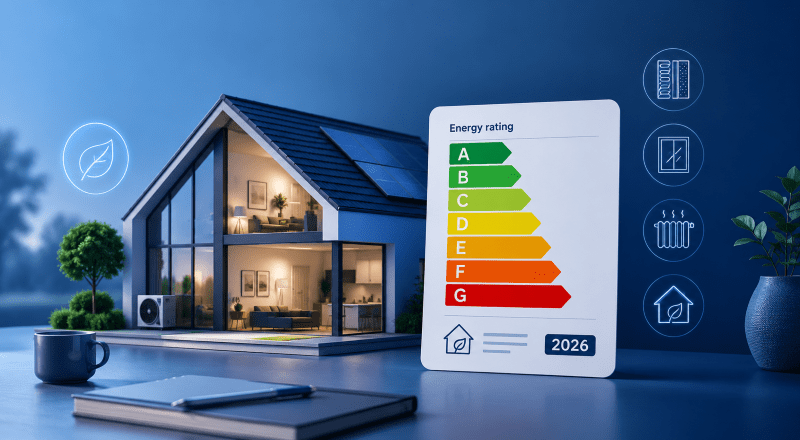
What Your Home’s EPC Colour Means in 2026: Interior colours can suggest personality, comfort or taste. An EPC colour communicates something more measurable.
It shows how efficiently a property is expected to use energy. It may also highlight improvements that could reduce energy demand.
A green result generally indicates stronger performance. Yellow suggests average efficiency. Orange or red points towards greater improvement potential.
However, the colour alone does not explain the whole property.
At a Glance
An Energy Performance Certificate rates a home from A to G.
- Dark green A or B: Higher energy efficiency.
- Light green or yellow C and D: Moderate energy efficiency.
- Orange or red E, F and G: Lower energy efficiency.
Your certificate also contains estimated costs and recommended improvements.
Check the full report before arranging work or making a mortgage decision.
What Is an Energy Performance Certificate?
An Energy Performance Certificate, known as an EPC, measures a property’s energy performance.
Domestic properties receive a rating from A to G. A is the highest rating, while G is the lowest.
The assessment considers features including:
- Wall, floor and roof construction.
- Insulation levels.
- Windows and glazing.
- Heating systems.
- Hot water systems.
- Lighting.
- Renewable energy technology.
The result is based on an approved assessment method. It is not calculated from the occupant’s actual energy bills.
A careful household may use less energy than the certificate predicts. Another household may use more.
You can find an existing energy certificate through GOV.UK.
What Do the EPC Colours Mean?
The familiar EPC chart uses colours to make technical information easier to read.
The colour provides an immediate indication. The letter and numerical score provide the more precise result.
Green: EPC Ratings A and B
Dark green usually represents ratings A and B.
These homes tend to have stronger energy-efficient features. They may include effective insulation, modern heating or renewable technology.
However, a high rating does not guarantee low bills.
Actual costs still depend on:
- Energy prices.
- Household size.
- Heating habits.
- Room temperatures.
- Appliance use.
- Time spent at home.
The EPC measures the building’s expected performance under standard assumptions.
Light Green and Yellow: EPC Ratings C and D
Ratings C and D cover a broad middle range.
Many existing UK homes fall within these bands. Their performance can vary considerably despite sharing a similar colour.
One property may need only modest improvements. Another may require changes to insulation, glazing or heating controls.
The recommendation section should therefore be reviewed alongside the headline rating.
A yellow rating is not automatically poor. It indicates that the property may have practical opportunities for improvement.
Orange and Red: EPC Ratings E, F and G
Orange and red ratings indicate lower measured energy efficiency.
Possible reasons include:
- Limited insulation.
- Older heating systems.
- Single glazing.
- Heat loss through walls or roofs.
- Inefficient hot water systems.
- Restricted heating controls.
This does not mean every recommended measure should be completed immediately.
Older, listed or unusually constructed buildings may require specialist advice. An unsuitable installation could create moisture or ventilation problems.
The correct improvement must suit the building, not only the certificate.
Why Should Homeowners Care About Their EPC Colour?
An EPC can help a homeowner understand how the building performs.
It may be relevant when:
- Selling a property.
- Buying a home.
- Planning renovation work.
- Reviewing energy costs.
- Considering a remortgage.
- Comparing mortgage products.
- Preparing a property for later life.
- Reviewing a buy-to-let property.
An EPC is required when many properties are built, sold or rented.
For landlords, separate minimum energy-efficiency rules may also apply. Current government guidance generally requires qualifying privately rented homes to reach at least EPC E.
Homeowners should check current rules before relying on an older article or certificate.
Does an EPC Rating Affect a Mortgage?
An EPC rating does not usually determine mortgage approval by itself.
Lenders mainly consider affordability, credit history, property condition, valuation and their lending criteria.
However, energy performance can still become relevant.
Some lenders offer products or incentives for qualifying energy-efficient properties. Requirements differ between providers.
A lender may request:
- A valid EPC.
- A minimum qualifying band.
- Evidence that improvements were completed.
- A new assessment after the work.
- Completion within a stated period.
The incentive should be considered alongside the mortgage rate, fees and product conditions.
Mortgage advisers also need accurate property information when considering energy-efficient lending. Connect Brokers explains the technical issues within its guide to EPC ratings and buy-to-let lending.
Which EPC Improvements Should You Consider First?
The certificate normally lists possible improvements in a suggested order.
Common measures can include:
- Improving loft insulation.
- Adding suitable wall or floor insulation.
- Installing heating controls.
- Replacing inefficient lighting.
- Improving windows or doors.
- Upgrading the heating system.
- Considering solar energy.
The recommendations are a starting point rather than a quotation.
Before commissioning work:
- Check the certificate’s date.
- Confirm whether the property has changed.
- Obtain suitable professional advice.
- Request more than one quotation.
- Consider ventilation and moisture control.
- Check warranties and installer standards.
- Arrange a new EPC where appropriate.
A certificate may remain on the register after work has been completed. A new assessment may be required to record the improvements.
How Could Home Improvements Be Funded?
Some improvements can be paid for from savings. Larger projects may require broader financial planning.
Possible routes can include:
- Using available savings.
- Completing work in stages.
- A further advance from an existing lender.
- Remortgaging and raising capital.
- A second charge mortgage.
- Later-life lending.
- Equity release for eligible homeowners.
Each route has different costs and risks.
Borrowing over a long term can make an improvement more expensive overall. Early repayment charges may also apply when changing an existing mortgage.
Older homeowners can compare equity release and remortgaging for home improvements.
Those considering a separate secured loan can also read the second charge mortgage guide.
Your EPC Colour Is a Starting Point
A home cannot be fully understood through one colour.
The EPC provides a structured assessment, but the building still needs context.
Its age, construction, condition and future use all matter.
Green may indicate stronger efficiency. Yellow may reveal reasonable performance with room for improvement. Red may identify more substantial work.
The most useful question is not simply, “What colour is my house?”
It is, “What does this result tell me to examine next?”

Frequently Asked Questions
What is the best EPC colour?
Dark green is the highest section of the EPC scale. It normally represents ratings A and B.
Is a yellow EPC rating bad?
Not necessarily. Yellow commonly represents a mid-range rating. Review the numerical score and recommended improvements for greater detail.
How long is an EPC valid?
An EPC is generally valid for ten years. However, obtaining a new assessment may be useful after significant improvements.
Can I improve my EPC rating?
Potentially. Insulation, heating controls, glazing and suitable renewable technology may improve performance. Results depend on the property.
Will a better EPC rating increase my property’s value?
It may make the property more attractive to some buyers. However, value also depends on location, condition, demand and other features.
Do I need mortgage advice before funding improvements?
Mortgage advice can be useful when borrowing is being considered. An adviser can explain affordability, product costs and available lending options.
Your home may be repossessed if you do not keep up repayments on your mortgage or loans secured on it.